
.avif)
.avif)
TL;DR:
Strategy tools fall into four types. Planning tools like SWOT, PESTLE, and Porter's Five Forces help you analyze and decide. Management tools like strategy maps, stakeholder engagement plans, and portfolio management drive execution. Tracking tools like KPI dashboards, scorecards, and strategy reports monitor progress. Strategy software like Cascade brings all three into one place. Most teams pair a few planning frameworks with one platform to deliver them.
An estimated 67% of well-formulated strategies fail because of poor execution, not poor design, according to Harvard Business Review. The tools below cover the full process, from the frameworks that shape a plan to the software that gets it done. Each entry includes what the tool does and when to use it, with free templates where we have them.
Strategic Planning Tools
Planning tools help you analyze where you stand and decide where to go. Most are frameworks: structured thinking models you can run on a whiteboard or in a document, at no cost. They split into analysis frameworks, growth and choice frameworks, and goal-setting frameworks.
Analysis frameworks
1. SWOT Analysis
.avif)
SWOT analysis is a framework that allows organizations to analyze both internal factors (strengths and weaknesses) and external factors (opportunities and threats), providing a complete picture.
👉🏻 Use this guide with free template to help you identify strengths, weaknesses, opportunities, and threats you should consider when evaluating your strategic options.
2. PEST Analysis
PEST Analysis helps you to analyze Political, Economic, Social, and Technological factors that could impact your strategy. This strategic framework is a great starting point, providing helpful context for strategic planning and setting business direction. Use it early, when you need outside context before bigger decisions.
PESTLE is the fuller version.
3. PESTLE Analysis
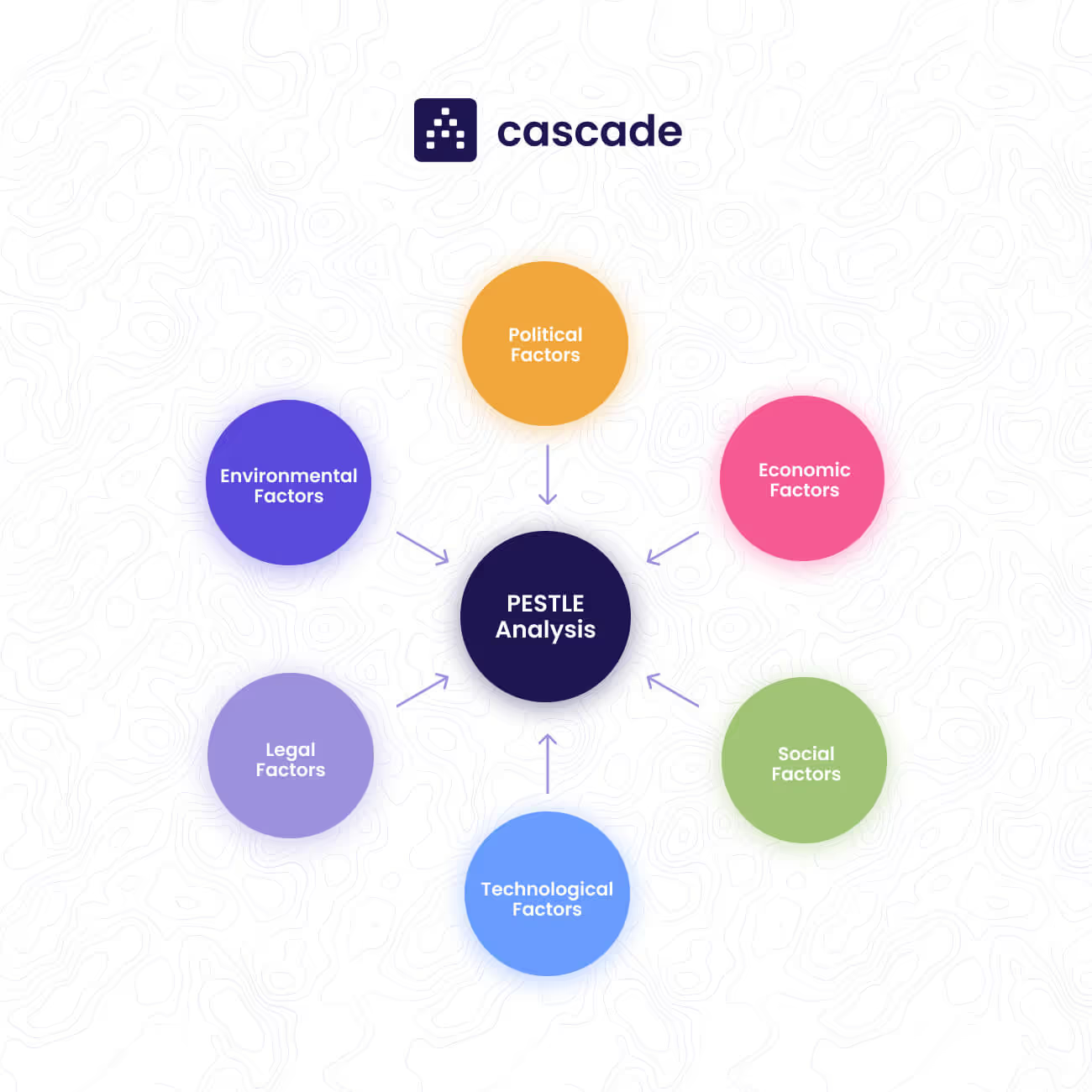
PESTLE Analysis is an expanded version of a PEST Analysis. It adds two more external factors to your analysis: Legal and Environmental factors. Use it when planning a long-term pivot or preparing for regulatory or economic shifts.
👉🏻 Grab a simple PESTLE Analysis Template here.
4. Porter's Five Forces model
.avif)
Porter's framework (introduced by Michael Porter) helps you identify five forces that place competitive pressure on a company in any given industry. It focuses on these five dimensions: threat of new entrants, bargaining power of suppliers, bargaining power of buyers, threat of substitutes, and competitive rivalry. Use it before entering a market, launching a product, or repositioning.
👉🏻 Grab your free Porter's Five Forces Template in PDF format and streamline your analysis!
5. VRIO Analysis
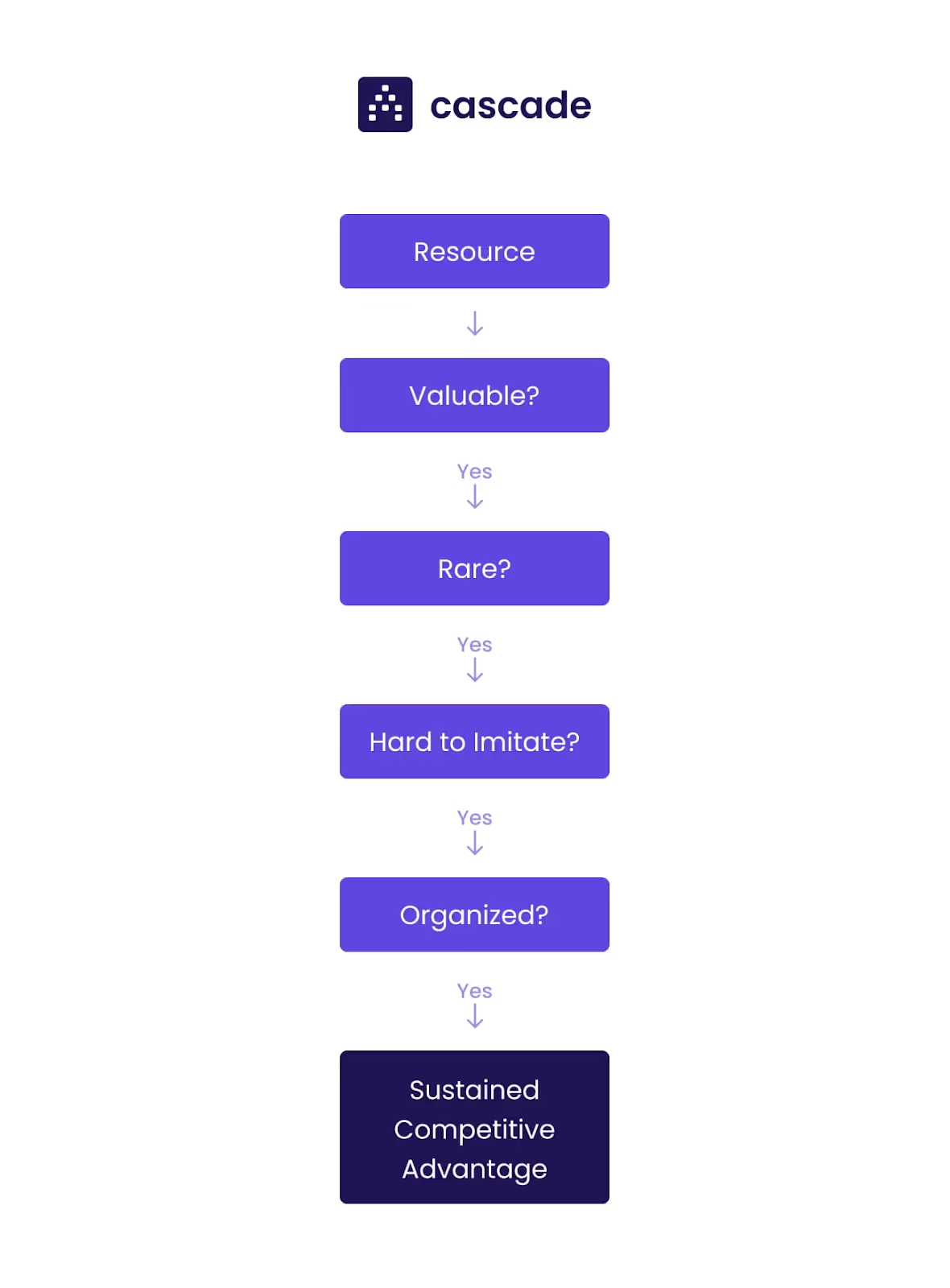
VRIO Analysis is a framework that helps you uncover and assess your business's competitive advantages by analyzing resources based on Value, Rarity, Imitability, and Organization. Use it when your question is what you can uniquely win with. It goes deeper than SWOT on internal advantage.
👉🏻 Get started with our free VRIO template to make the process even easier.
6. McKinsey 7S Framework

McKinsey 7S framework is a strategic planning tool will help you identify strategic alignment between departments and processes by analyzing 7 components: structure, strategy, systems, skills, style, staff, and shared values. Use it during transformation or when strategy and organization feel out of sync.
👉🏻 Grab your template in this free collection of templates for internal analysis.
7. Value Chain Analysis
.avif)
Value Chain Analysis breaks down each step in the production process, helping you identify and analyze all related activities to improve efficiency. Use it when reviewing operations or where to invest.
Use this template to get started.
8. Four Corners Analysis
.avif)
Four Corners Analysis offers a deeper look into competitor behavior by examining their drivers, strategies, assumptions, and capabilities. It’s a powerful tool for understanding your competitors’ likely moves, which can guide your own strategic responses. Use it when competitive response is a major factor in your decision.
9. GAP Analysis
%2520(1).avif)
GAP Analysis is a method for understanding the gap between where you're today (your current state) and what you need to do to get where you want to be as a company (your desired future state). Use it when turning a vision into concrete, prioritized actions.
👉🏻 Grab your free template (Excel) to easily conduct a Gap Analysis.
10. Strategy Maturity Assessment
.avif)
Assessing your organization’s strategic maturity is a useful way to establish a baseline for planning. A maturity assessment evaluates the clarity of your strategic vision, goal-setting effectiveness, data usage, governance, and communication. Use it at the very start to baseline where your strategy capability stands.
👉 Take our free 10-minute Strategy Maturity Assessment quiz to get a personalized snapshot of your organization’s current capabilities.
📚 Recommended read: What Is A Maturity Model? Overview, Examples + Free Assessment
Growth and choice frameworks
11. Ansoff Matrix
.avif)
The Ansoff Matrix is a tool to help you determine which of four strategic directions best supports your growth strategy. Its four quadrants include market penetration, product development, market development, and diversification. Use it when deciding where to put resources across products or units.
👉🏻 Grab your free Ansoff Matrix template to explore examples for each quadrant and streamline your business growth planning.
12. BCG Matrix
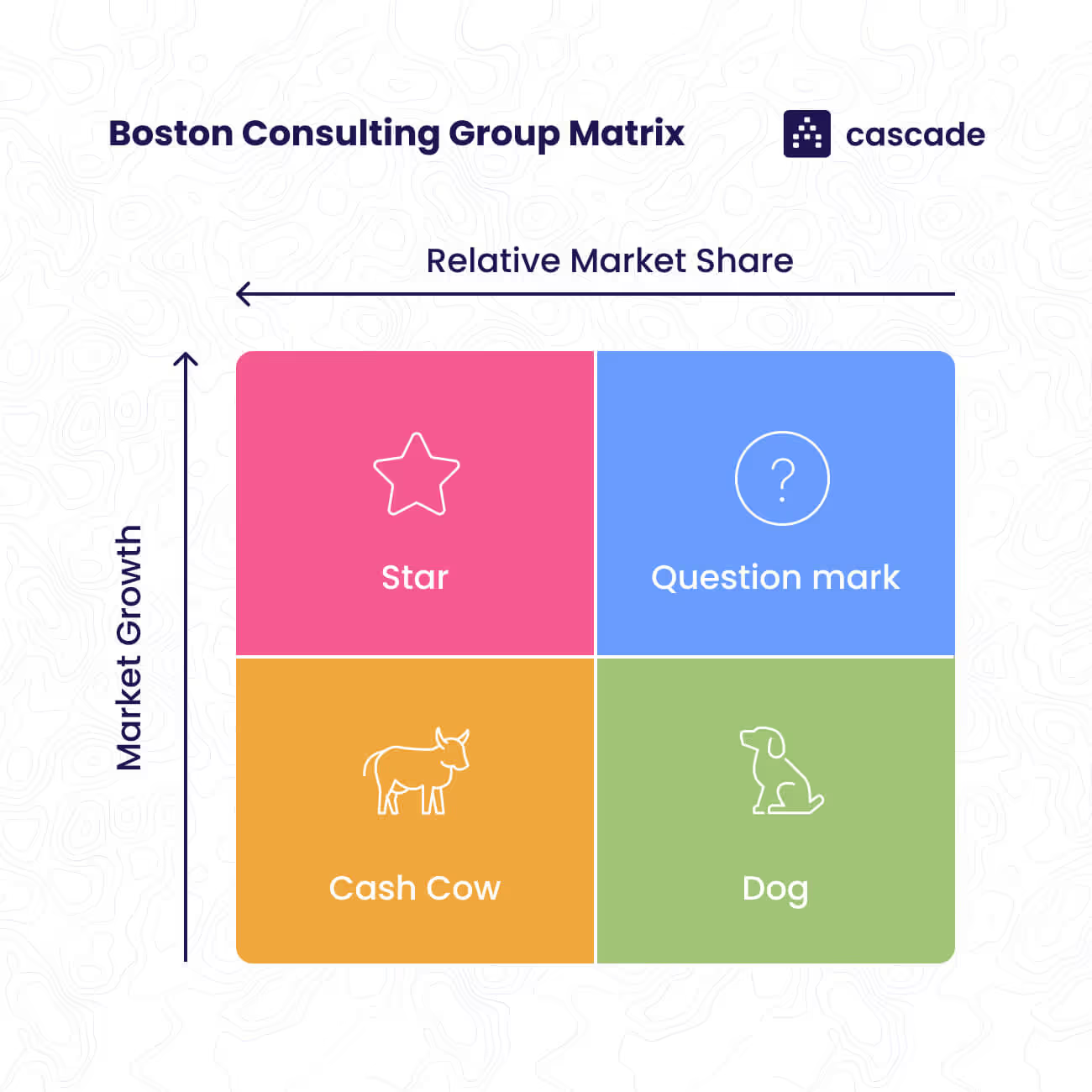
The BCG Matrix is a portfolio tool from Boston Consulting Group that helps companies prioritize their different businesses by their degree of profitability. It plots units by market growth and market share to guide where to invest, hold, or divest. Use it when deciding where to put resources across products or units.
You can find a free BCG matrix template here.
13. GE Matrix
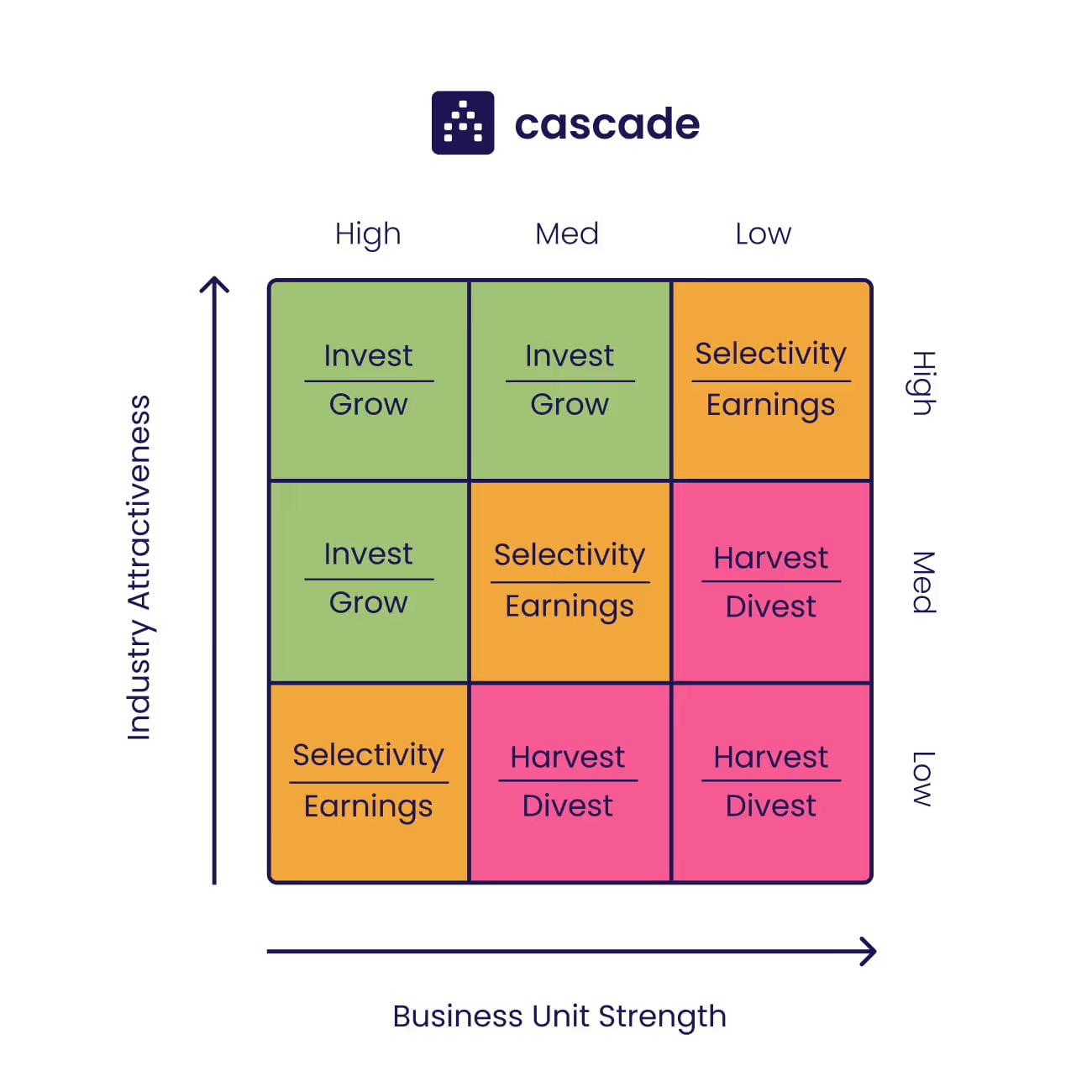
McKinsey's GE Matrix is a visual tool designed to help portfolio managers determine resource allocation and analyze the best strategic direction for multi-business portfolios. Along with providing an overview of business units' performance, the GE Matrix also prescribes three strategic paths (grow, hold, and harvest) to inform strategic decisions. Use it for larger portfolios that need more nuance than the BCG Matrix.
14. The Business Model Canvas
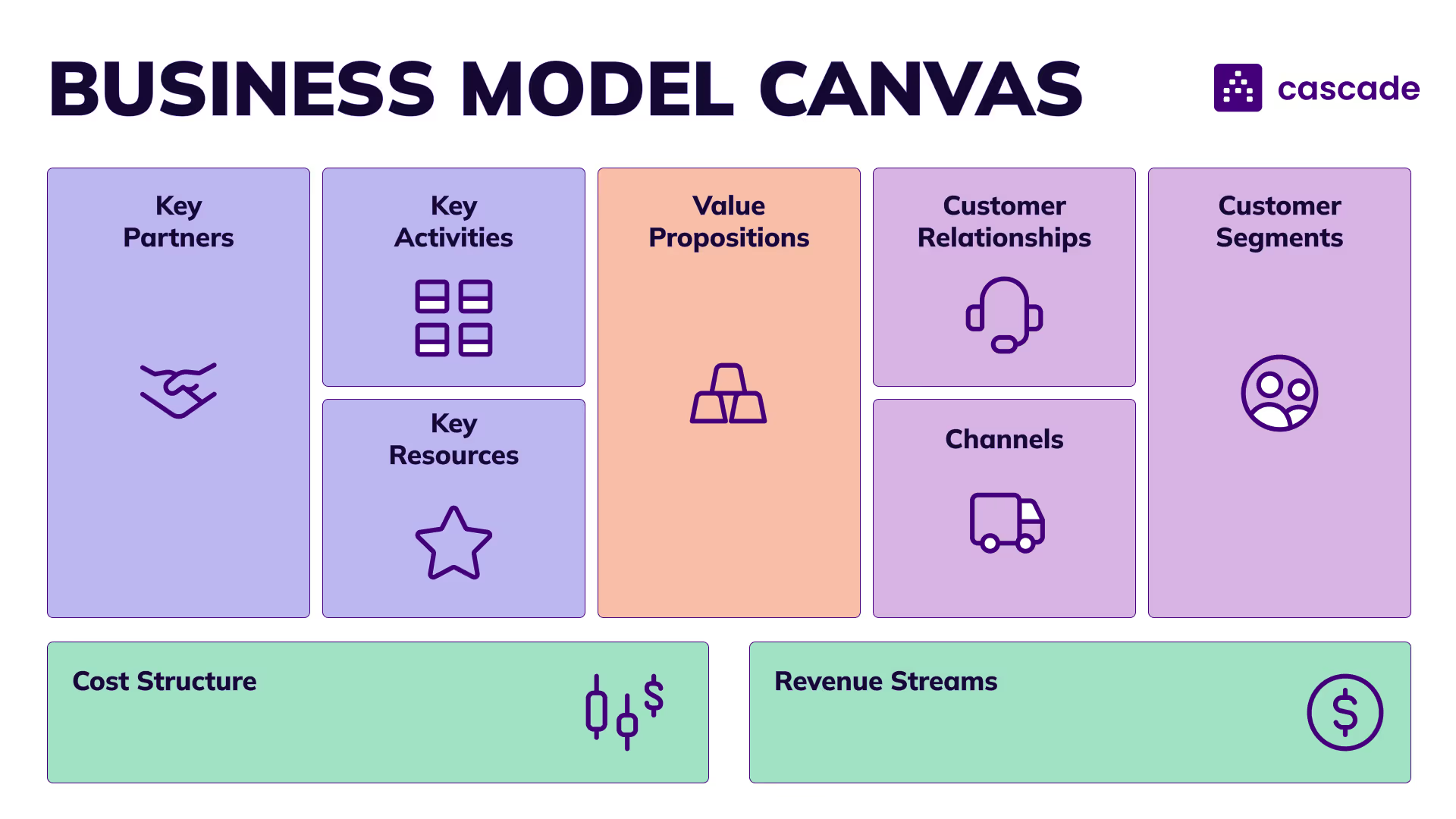
The Business Model Canvas is a one-page canvas covering nine building blocks, from customer segments to revenue streams, for mapping how a business creates and captures value. Use it for new ventures or when rethinking a model, whether you are an existing business or a fast-growing start-up.
15. Scenario Planning
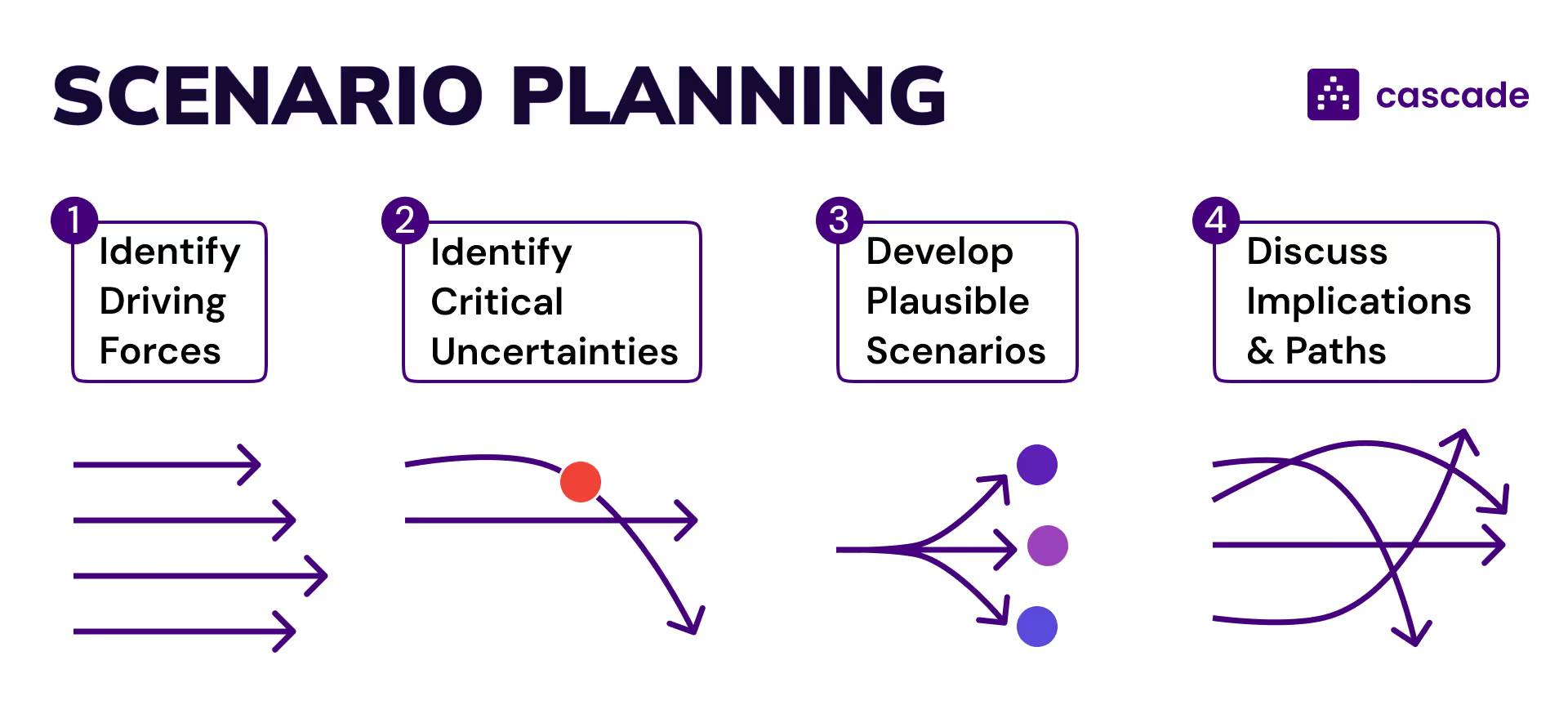
Scenario Planning is a method for building several plausible future scenarios and testing your strategy against each, rather than betting on one forecast. It's particularly useful in uncertain or rapidly evolving industries where a single plan is too fragile, helping you anticipate and adapt to potential changes.
Strategy formulation and goal-setting tools
Analysis tells you where you stand. Strategy formulation is where you decide what to do about it: set the goals and build the plan to reach them. The tools below give that decision a structure.
16. Vision Statement Toolkit
A vision statement is a short declaration of where the organization is headed and why, and it sets the direction every other goal hangs off.
👉 This free toolkit helps you craft your organization’s vision with tools like a 4-step builder, 100+ sample statements by industry, and a vision-to-execution guide—in PDF and Excel formats.
17. Values Toolkit
Strategic values are the principles that guide how an organization makes decisions and behaves. A values toolkit helps you define them as a clear set and pin down what each one means in practice. Work through it alongside the vision, since values shape the culture the strategy has to run through.
👉 This free Excel-based strategy toolkit will help with that process.
💡When is the right time for a makeover of your company's vision and values? It's a good move when dealing with significant organizational changes, growth slowdowns, or cultural issues because it can boost motivation.
18. OKRs (Objectives and Key Results)
OKRs are a goal-setting framework that pairs ambitious Objectives with three to five measurable Key Results. Use them to translate strategy into a few priorities and a continuous operating rhythm.
👉 Use this free OKR Template (in Excel format) to set and track objectives and key results. You can track company, team, or individual OKRs.

19. Balanced Scorecard
%2520(1).avif)
The Balanced Scorecard is a framework that tracks performance across four perspectives: Financial, Customer, Internal Processes, and Learning and Growth. Use it when you need a view of organizational health beyond financials. It also doubles as a tracking instrument.
Cascade is the Balanced Scorecard Institute's endorsed strategy platform. The Balanced Scorecard Institute, which has trained and certified practitioners in the methodology across more than 80 countries since 1998, formally recommends Cascade as the software for running it. Learn more about the partnership.
20. Hoshin Kanri
Hoshin Kanri is a method for cascading top-level priorities down to frontline activity. Use it in operations-heavy organizations that need tight alignment between long-term goals and daily work.
👉 Learn more about Hoshin Kanri in this article.
21. OGSM
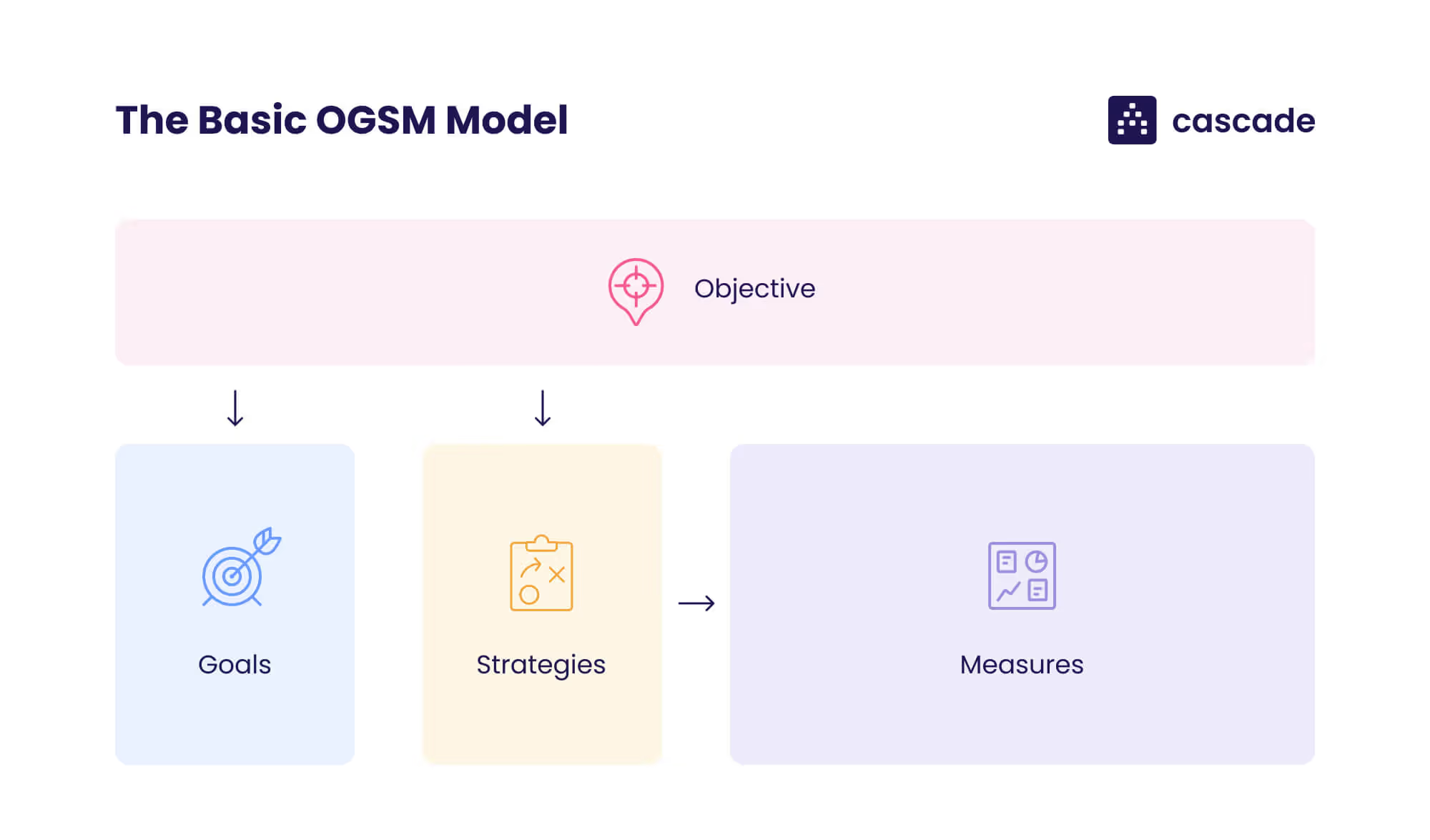
OGSM is a planning framework that structures a strategy around four connected levels: Objectives, Goals, Strategies, and Measures. The naming convention gives every part of the plan a place, from the qualitative aim down to the metric that proves it. You can build that structure into a platform like Cascade so it becomes a live plan rather than a static document.
👉 Learn more about OGSM here!
22. V2MOM
V2MOM is a planning framework that structures a strategy around Vision, Values, Methods, Obstacles, and Measures, popularized by Salesforce. It forces you to name what stands in the way, not just where you are headed. Like OGSM, it works as a naming convention you can run across a whole organization in a dynamic platform like Cascade or you can simply have it as a one pager document for your company.
Whatever model or framework you use to formulate your strategy, you can make sure it stays dynamic and track that you're actually executing on your plans with Cascade, our AI-powered strategy execution platform. Cascade's flexible strategy model allows to customize your strategy and terminology any way you want, adopting an existing model or framework or customizing it fully to match your organization.

Strategic Management Tools
The second phase of the strategic management process is executing the strategic plan you created earlier—the most crucial part of every strategy. Management tools move the plan from paper into action and keep teams aligned around it. This is the phase where strategies tend to fall apart, as priorities blur, ownership scatters, and the plan drifts from what teams actually do.
23. Strategy Maps
Strategy maps are a visual that shows how objectives connect through cause and effect, so teams can see how their work rolls up to the bigger goals. They're often paired with the Balanced Scorecard but you can actually use them with any framework or setup. They're a great tool to communicate the plan and spot misalignment.
In Cascade we have our own version of the strategy map: our Alignment Map feature that helps you visualize the alignment of objectives across multiple strategic plans, giving you complete visibility into the execution web that's spinning inside your organization. As a result, you can quickly identify any risks or roadblocks, prioritize critical initiatives, and eliminate misaligned projects.
%2520(1).avif)
24. Strategic Roadmap

A strategic roadmap sequences your initiatives over time, so the plan has a delivery path instead of a flat list of goals. Use it to show what gets delivered when, and to keep execution moving in the right order rather than every initiative competing at once.
25. Stakeholder Engagement Plan
It all comes down to communicating your strategy and the why behind it. A Stakeholder Engagement Plan is a structured plan for communicating the strategy and the reasoning behind it to win buy-in. Use it at rollout, since execution stalls without commitment from the people delivering it.
👉 This free strategic engagement toolkit will help you plan out your strategic engagement plan to ensure you cover all the bases of effective strategy communication.
26. Collaborative Whiteboards (Miro, Mural)
Collaborative whiteboards like Miro and Mural are digital workspaces for running planning workshops and building frameworks visually with a distributed team. A strong starting point for analysis and communication, though not where you track execution over time.
Strategy Tracking Tools
The final phase of the strategic management process involves tracking the effectiveness of your strategy and then iterating where needed. Tracking tools measure whether the strategy is working and surface what needs to change. They turn execution into data leaders can act on.
Strategy tracking ensures that you’re meeting your short- and long-term goals by providing insights into what’s working and where adjustments are necessary. By using these tools, you can keep your strategy aligned with real-world results and ensure that every effort is driving meaningful progress.
27. Strategy Reports
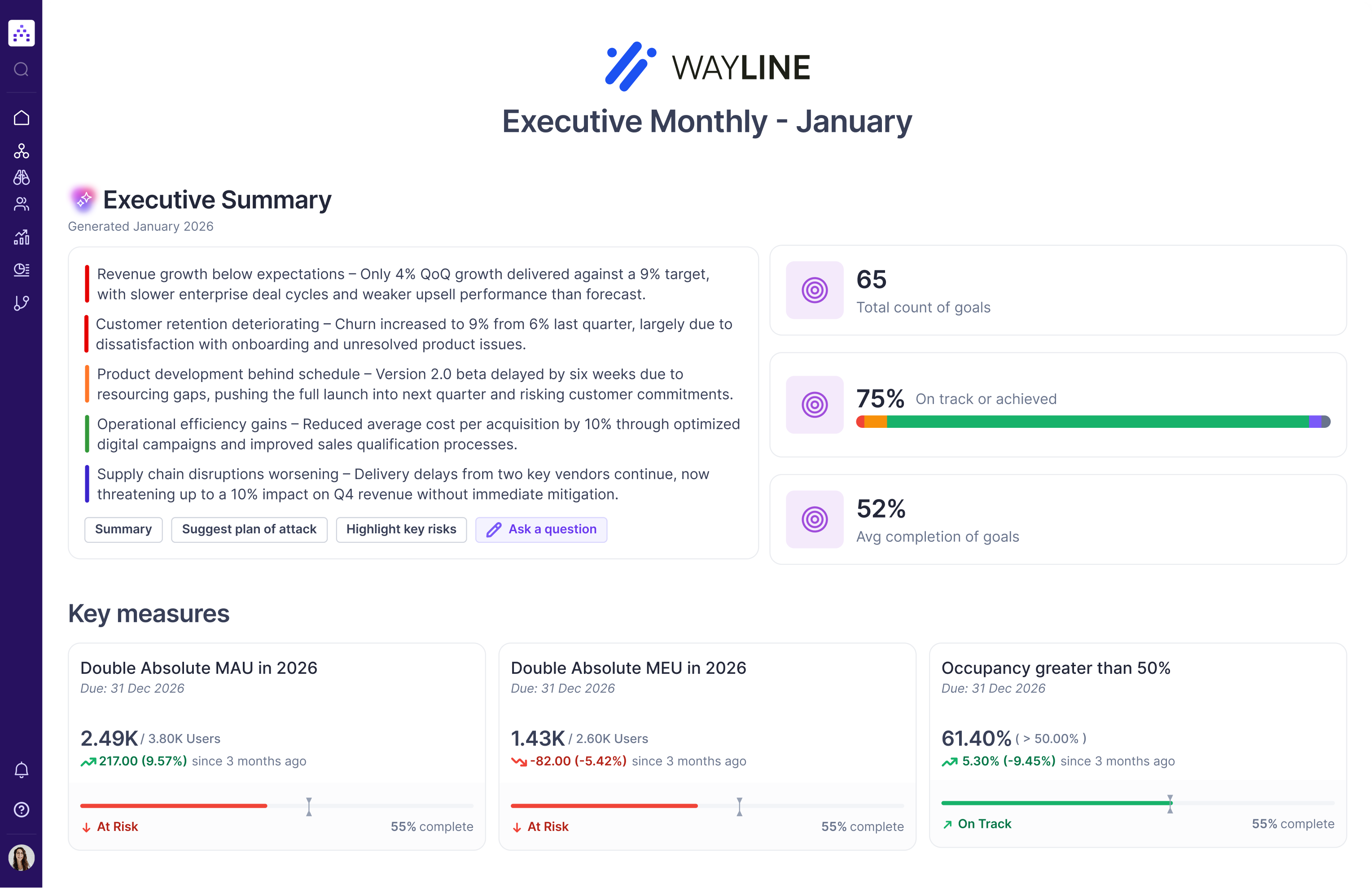
Strategy reports are drill-down reports that translate progress into a narrative for executives and the board. Use them for regular reviews and to keep decisions grounded in current data.
In Cascade, the report builds itself. Instead of exporting numbers into a slide deck the night before a review, Cascade pulls live data from across your strategy into drill-down reports and dashboards. Its AI drafts board-ready summaries, surfaces the risks that need attention, and shows variance against target, so what leadership reviews reflects where the strategy stands right now. See how reporting works in Cascade.
28. KPI Libraries and Dashboards
%2520(1).png)
A KPI library is a single place where all your metrics live, pulled from the systems that own the data instead of scattered across spreadsheets, and a dashboard gives you a live view of the ones that matter. The shift that makes it work is automation: connect your KPIs to your existing business tools and they update themselves in real time, so teams and leadership always see the same current numbers without anyone touching a spreadsheet.
👉 See how Cascade automates your KPI tracking
Not ready for live, automated tracking yet? The three templates below let you start by hand and move up later.
29. KPI Reporting Template (Excel version)
A KPI reporting template is a structured way to monitor metrics manually in a spreadsheet before you adopt any software. It's a great option to track key indicators when you are early in the process.
👉 Use this free Excel KPI Reporting template to manually monitor key metrics and stay on top of progress.
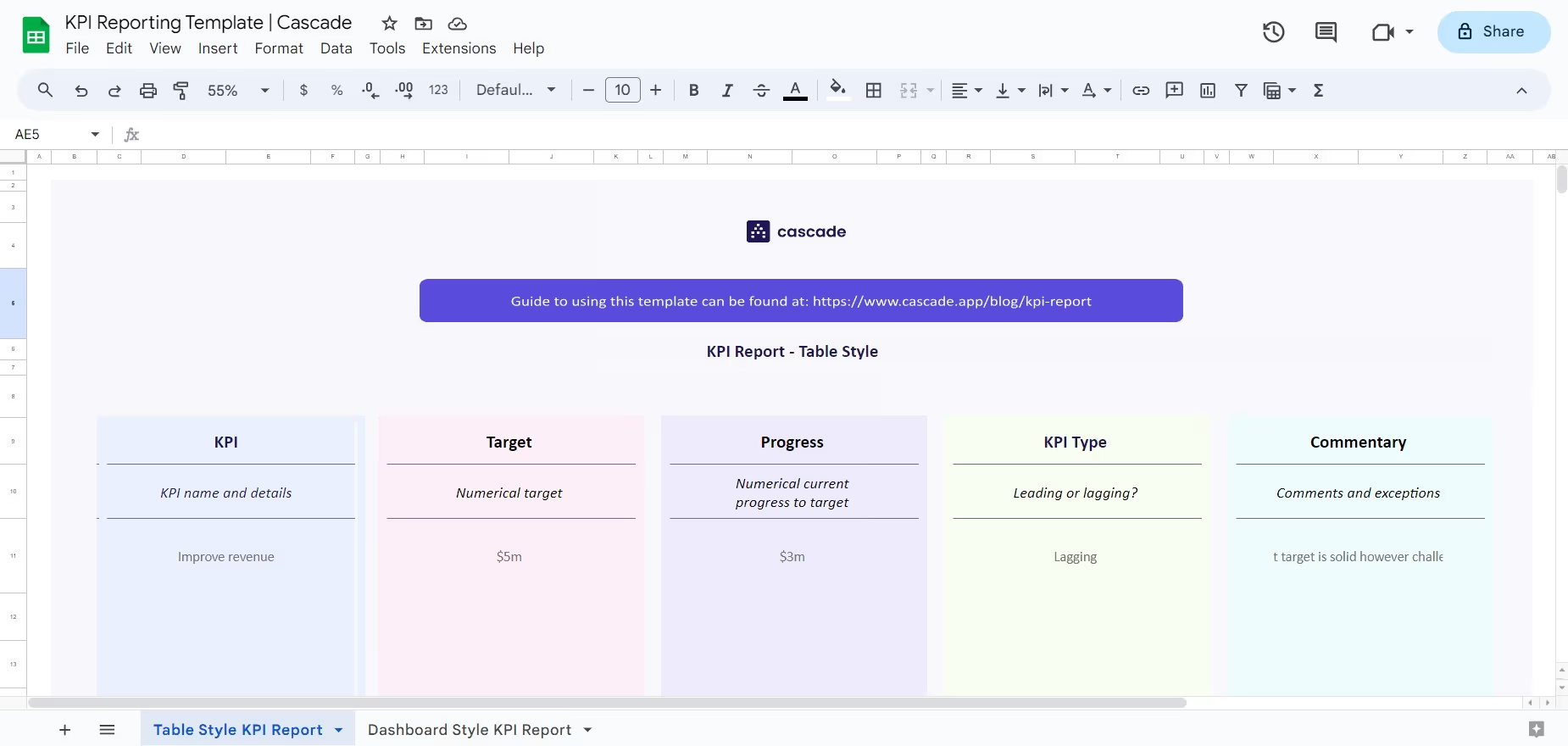
👉 To get started, check out our guide on writing KPIs in 4 steps and explore our online library of free KPI examples for various industries to inspire you.
30. OKR Excel Template (Excel version)

An OKR tracking template in Excel lets you set and track objectives and key results across company, team, or individual levels. It is a good starting point for keeping OKRs honest between quarters before you move to live tracking.
👉 Use this free OKR Template (in Excel format) to track company, team, or individual OKRs.
31. Operating & Financial Model Template (Excel format)
-p-800.avif)
An Operating & Financial Model maps your P&L statements, essential financial and operational metrics. Designed for CEOs, COOs, and CFOs, it helps you track revenue trends, monitor expenses, and identify optimization opportunities. By comparing actuals versus budget, you’ll gain clarity on your financial standing, allowing you to refine forecasts and allocate resources where they’re needed most.
👉 Access the Operating & Financial Model Template in excel with dynamic reports, to streamline financial tracking and strengthen your strategic alignment.
Strategy software and platforms
A framework gives you a plan. Software keeps that plan alive instead of letting it die in a slide deck, which is where the 67% execution gap lives.
For most organizations the strongest pick is Cascade, the #1 strategy execution platform rated 4.7 on G2, and built to connect a top-level strategy to the work and KPIs underneath it. The platforms after it are strong alternatives for more specific needs, from scorecard reporting to OKR-only programs.
32. Cascade
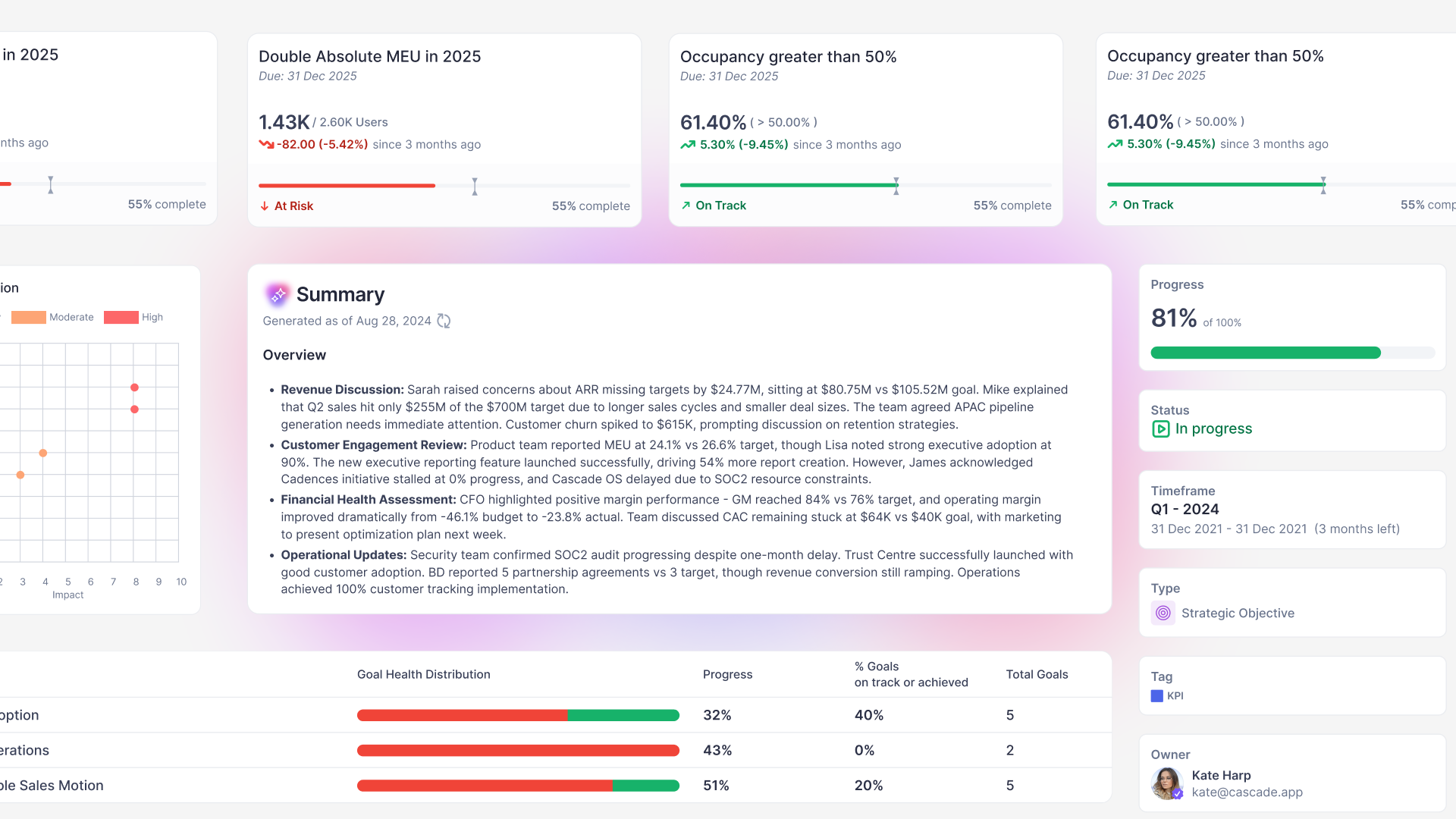
Cascade is an AI-native strategy execution platform that brings planning, execution, tracking, and decision-making into one system. You build the plan in the Planner, connect goals through Alignment Maps, centralize your metrics in the Metrics Library, and report on progress in real time.
Its AI pulls the numbers from your systems and the context from your meetings, emails, and documents, then shows you where to focus and what to do next. That intelligence engine is Tapestry AI, with Tapestry Connect feeding it context from across your tools.
Key features: Planner, Alignment Maps, Metrics Library, Reports, Strategy Cadences, Integrations, AI Insights, and Tapestry Connect.
Best for: Enterprise-wide strategy execution.
Best fit: Larger organizations that need a single source of truth to keep strategy from fragmenting across teams.
St. Jude's, U.S. Bank, PepsiCo, WWF, the University of Notre Dame, Roche, and Mitsubishi Power run their strategy on Cascade.
Rated 4.7 on G2 across 251 reviews.
33. The rest of the shortlist
ClearPoint Strategy is best for scorecard-driven performance management and reporting. Built around the Balanced Scorecard, it turns strategy data into dashboards and reports for teams already organized around scorecards and KPIs.
WorkBoard is best for OKR-led enterprise execution. It focuses on connecting OKRs to operating rhythm at scale, with automated check-ins across large teams.
Profit.co and Perdoo are best for organizations running strictly on OKRs, with alignment maps, check-in reminders, and goal-to-task linking.
monday.com, ClickUp, and Smartsheet are best for project and task execution rather than high-level strategy. A reasonable choice for small and mid-sized teams that want goals and daily work in one place.
How to choose the right combination
The reliable approach is to connect a planning framework to an execution platform. Pick the framework that fits the decision in front of you, then the software that fits how your leaders actually review progress.
Startup or small business: Run a quick SWOT, set quarterly goals with OKRs, and execute in a flexible tool like monday.com or a dedicated OKR platform.
Mid-sized company: Combine SWOT and PESTLE for diagnosis, set OKRs or a Balanced Scorecard for measurement, and run execution and reporting in Cascade.
Large enterprise or public sector: Use PESTLE and scenario planning for the outside view, a strategy map and Balanced Scorecard to structure the plan, and Cascade or a comparable platform to connect it to every team and track delivery.
Boost Your Strategy Execution With The Right Strategy Tools 🚀
Strategy planning models, tools, and templates are great for fleshing out your strategy, but to successfully execute strategy and adapt as needed, you also need the right software.
A great strategy execution platform will help you to create a single source of truth for your strategy, eliminating wasted time in disconnected strategy tools, confusion and potentially preventing a failed strategy execution.
A single home for your strategy will help you to keep everyone on the same page, allowing leaders to focus on the most critical parts of strategy execution: clear goals, context, and strategic prioritization.
And when you are not wasting your time in meetings to keep everyone aligned, you can focus on the greater purpose of actually helping your team members learn, grow, and deliver results
Cascade makes it easy to build strategic roadmaps and assign KPIs and owners to drive accountability. It lets your employees collaborate on shared goals to drive strategy execution across the organization.
👉 Interested in seeing Cascade in action? Get started for free or book a demo with Cascade's experts.
Frequently asked questions
What are the best strategy tools?
Strategy tools fall into four types. Planning tools like SWOT, PESTLE, Porter's Five Forces, and the Balanced Scorecard help you analyze and decide. Management tools like strategy maps drive execution. Tracking tools like KPI dashboards monitor progress. Strategy software like Cascade, ClearPoint, and WorkBoard combines all three. The right mix depends on your size, but a few frameworks plus one platform covers most organizations.
What are the best strategic planning tools?
The best strategic planning tools combine an analytical framework with an execution platform. For analysis, the most used frameworks are SWOT, PESTLE, Porter's Five Forces, the Ansoff Matrix, and VRIO. For goal-setting, teams use OKRs and the Balanced Scorecard. For executing and tracking the resulting plan, the most used software platforms include Cascade, ClearPoint, and WorkBoard. Most organizations pick one framework to set direction and one platform to deliver it.
What is the difference between strategy frameworks and strategy software?
Frameworks are thinking tools that help you analyze and choose a direction, and they cost nothing to use. Software platforms keep the resulting plan visible, connect goals to daily work, and track progress in real time. Frameworks tell you what to do. Software makes sure it happens.
Which strategy tool should I start with?
Start with a SWOT analysis to read your current position, then a PESTLE analysis for the external picture. Once you have a direction, set OKRs or a Balanced Scorecard to make it measurable, and choose an execution platform to track it. Beginning with analysis before tooling keeps you from buying software that does not fit how you plan.

.png)


